Corporate Wellness Coach Jobs: A Practical Career Path for Purpose-Driven Professionals
Years in a corporate environment are not a detour from a wellness career. Knowing how organizations work and how people respond to pressure is often

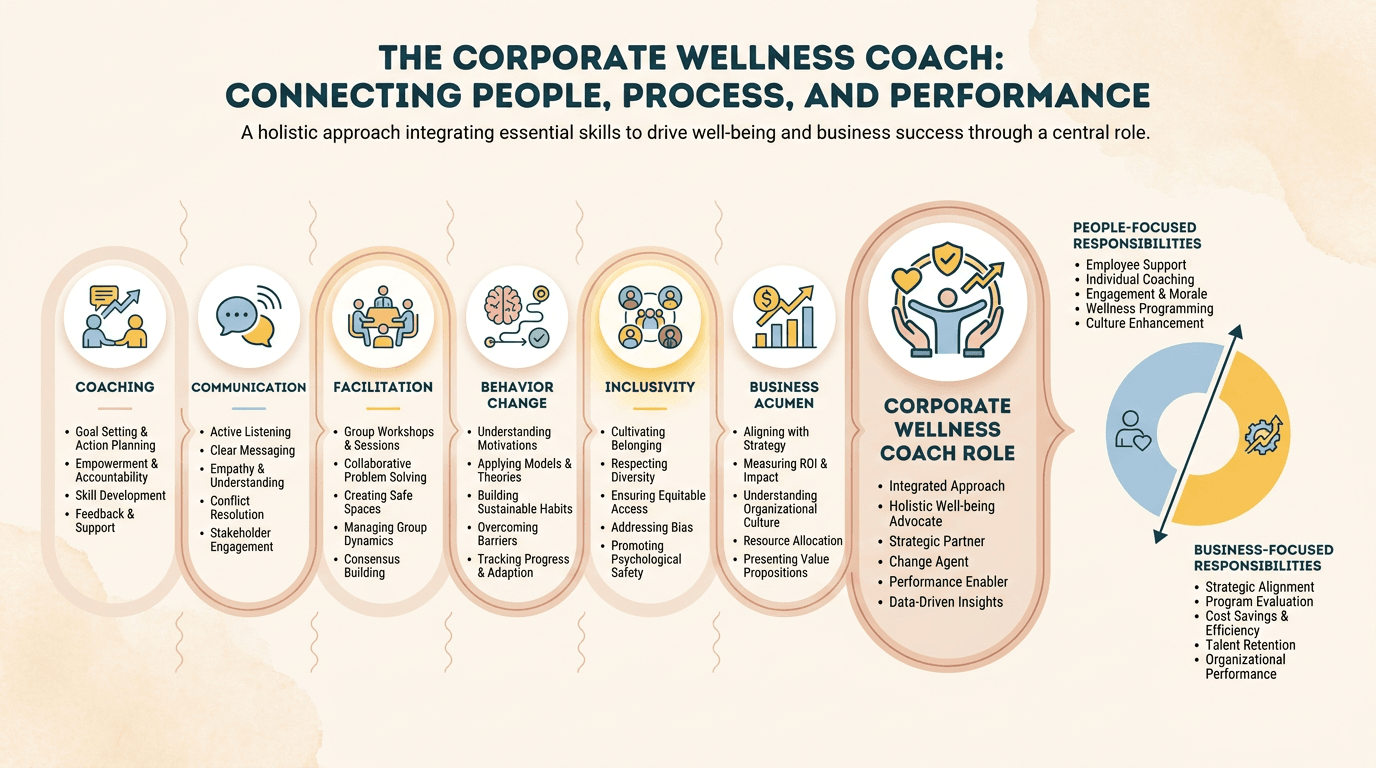
Years in a corporate environment are not a detour from a wellness career. Knowing how organizations work and how people respond to pressure is often what makes a coach effective. Corporate wellness coach jobs are growing, and professionals with that background are well-placed to lead in this space.
If you feel pulled toward wellness work, the right training can make that shift credible. A practical career path in corporate wellness is more accessible than many people expect. Gaja Collective offers an ICF-accredited, NBHWC-approved program designed for professionals ready to make that move.
What Does a Corporate Wellness Coach Do in a Workplace Setting?
A meditation app or a fruit bowl in the break room rarely creates lasting change for employees. Understanding what a corporate wellness coach does in a workplace setting means looking beyond surface-level perks. The role is more operational, more relational, and more culturally embedded than most people expect.
It Goes Beyond Leading Wellness Activities
Corporate wellness coaches do more than run lunchtime yoga sessions or share stress tips in a newsletter. They work across departments to design programs, coach employees one-on-one, and help shift how teams think about health. According to the NBHWC scope of practice, coaches focus on client-driven goals and evidence-based behavior change, not clinical advice or prescriptive health plans.
Turning Broad Goals Into Measurable Support
Much of the work involves helping employees make real changes in areas like stress, sleep, movement, and burnout prevention. Research on health coaching shows that effective coaching is individualized, targeting specific lifestyle domains with clear, trackable goals. This is what separates a wellness program that employees actually use from one that collects dust on the intranet.
Understanding the Workplace, Not Just Wellness
Effective coaches also understand how organizations work. They earn leadership buy-in, protect employee confidentiality, and build programs that work for diverse teams with different schedules, abilities, and comfort levels. The International Coaching Federation notes that coaching works best when woven into how a company operates day to day, not offered as a one-off activity.
Core Responsibilities Behind Corporate Wellness Coach Jobs
Corporate wellness coaching covers more ground than most people expect. Beyond one-on-one sessions, coaches are often involved in program design, implementation, and outcome tracking, making this a role that rewards both coaching presence and practical program management.
Conduct individual coaching sessions focused on goal-setting, behavior change, and accountability, helping employees build sustainable habits around stress, sleep, movement, and energy management.
Facilitate group workshops and wellness challenges that engage teams across different departments, schedules, and comfort levels, often requiring the ability to read a room and adapt on the spot.
Refer employees to appropriate clinical or mental health resources, staying within the scope of practice defined for health and wellness coaches, an important professional boundary that protects both coach and client.
Track participation and report outcomes to HR or leadership, translating wellness activity into data that helps organizations understand what is working and where to focus their efforts.
Customize programming for different employee populations, from remote workers managing screen fatigue to frontline staff who need realistic, low-barrier strategies that fit into a demanding shift schedule.
Design inclusive experiences that account for cultural backgrounds, physical abilities, privacy preferences, and each person's readiness to change, all skills that Gaja's coach certification curriculum is specifically built to develop.
Why Corporate Wellness Coaching Is a Good Career for Purpose-Driven Professionals
Corporate wellness coaching is a rewarding career path for purpose-driven professionals because its impact reaches far beyond one-on-one conversations. A single coach working inside an organization can shift how entire teams approach stress, movement, and daily habits. One large-scale review found that workplace wellness programs with multiple components produced measurable improvements in employees' health behaviors. A separate randomized trial found similar gains in exercise and weight-management activity. Few careers let you influence that many people at once.
If you've spent years in a corporate environment, that experience travels with you. You already understand how to earn trust with leadership, communicate across departments, and work within real organizational constraints. And if your practice includes yoga, meditation, or holistic health, this career offers a practical path into everyday workplaces. You don't need to open a studio or go fully independent to do work that matters. The Total Well-Being Coach Certification from Gaja Collective is built to help practitioners move from personal practice into professional, accredited coaching.
What Skills Are Needed for Corporate Wellness Coach Jobs?
A background in yoga or meditation is a genuine asset in corporate wellness. The skills needed for corporate wellness coach jobs go beyond personal practice, though. Hiring managers look for a specific combination of coaching skill, business awareness, and the ability to meet diverse employees where they are. That broader skill set is good news for professionals with corporate backgrounds, where many of those abilities are already in place.
Coaching Presence Is a Professional Skill
Presence is not about being warm or likable. It is a trainable skill. The ICF core competencies were developed through a job analysis of over 3,000 coaches. They identify active listening, powerful questioning, and direct communication as professional standards. Day to day, this looks like staying fully attentive during sessions and asking questions that open thinking rather than offering advice. It also means holding space for accountability without judgment. Coaches who understand trauma-informed facilitation bring an added layer of safety and trust to those interactions.
Business Fluency Sets You Apart
Knowing how to coach is one thing. Knowing how to communicate the value of that coaching to an HR director is another. Coaches who can frame wellness outcomes around engagement, retention, or reduced burnout are far more hireable. The NBHWC content outline includes professional practice and business skills as part of its national certification framework. This signals that organizations expect coaches to operate as credible partners in employee well-being, not just session facilitators.
The Blended Skill Set Employers Want
Research on group health coaching highlights facilitation skills, cultural sensitivity, and program evaluation as qualities that set experienced coaches apart. Employers want coaches who can design inclusive experiences, track participation trends, and adapt their approach for different employee populations. The Gaja certification syllabus covers evidence-based coaching frameworks alongside applied domains like sleep, movement, and stress resilience, building the kind of well-rounded capability that gives coaches real confidence in professional settings.
Do You Need a Certification to Become a Corporate Wellness Coach?
It is one of the most common questions from professionals considering this path: do you need a certification to become a corporate wellness coach? Technically, no law requires one. But in a competitive hiring market, a recognized credential is often what separates candidates with structured training from those relying on personal experience alone.
Employers are increasingly expecting formal credentials. Many organizations now look for coaches trained in evidence-based methods, professional ethics, and scope of practice, because it reduces organizational risk and signals that a coach can work responsibly within a workplace setting.
The NBC-HWC is the national benchmark many employers reference. Offered by the National Board for Health and Wellness Coaching, the NBC-HWC credential requires completion of an approved training program and at least 50 documented coaching sessions before sitting for the board exam.
Not all certifications carry the same weight. Programs accredited by recognized bodies like the International Coaching Federation (ICF) or approved by the NBHWC demonstrate that the curriculum meets established standards for coaching competency, ethics, and professional practice, which matters to employers evaluating candidates.
If you are coming from a non-clinical background, certification bridges the credibility gap. A respected credential translates your personal wellness experience into professional language that hiring managers can evaluate with confidence. Certification paired with mentorship and supervised practice hours gives career changers the most credible foundation.
The Gaja Coach Certification is both ICF-accredited and NBHWC-approved, pairing evidence-based coursework with practical coaching frameworks, mentorship, and community support, so you graduate with practical skills and professional confidence.
What Companies Hire Corporate Wellness Coaches and How Much Do They Make?
The organizations that hire corporate wellness coaches range much more widely than most career changers expect. Beyond large corporations, roles exist across wellness vendors, health insurers, hospitals, universities, and government agencies, with Bureau of Labor Statistics data showing a national median wage of around $62,860 annually for health education specialists, though pay varies by employer type, credential level, and region. Research on employer wellness programs confirms that demand for coaches spans a wide range of organizational types, and candidates with accredited credentials, like those outlined in the Gaja Coach Certification syllabus, are increasingly well-positioned across these settings.
Employer Type | Typical Role Format | Common Responsibilities | Desired Credentials | Estimated Pay Range |
|---|---|---|---|---|
Large Corporations | Full-time, salaried | One-on-one coaching, wellness challenges, program coordination, employee engagement | ICF or NBHWC certification; bachelor's preferred | $55,000–$85,000/yr |
Wellness Vendors & Platforms | Salaried or contract | Virtual coaching, group workshops, content delivery, outcome tracking | Accredited wellness coaching certification | $45,000–$75,000/yr |
Employee Assistance Program (EAP) Providers | Contract or part-time | Short-term coaching, behavioral support, referral coordination | Professional coaching credential; counseling background helpful | $40,000–$70,000/yr |
Health Insurance Companies | Full-time, salaried | Member health coaching (phone/video), wellness program delivery, case coordination | NBHWC-approved certification preferred | $50,000–$80,000/yr |
Hospitals & Health Systems | Full-time, salaried | Staff well-being programs, patient lifestyle coaching, group facilitation | Health coaching certification; clinical exposure helpful | $50,000–$78,000/yr |
Ambulatory Care / Outpatient Clinics | Salaried or contract | Chronic disease lifestyle coaching, behavior change support | NBHWC preferred; familiarity with clinical settings an asset | $45,000–$72,000/yr |
Universities & Colleges | Full-time, salaried | Student and staff wellness programs, workshops, individual coaching | Bachelor's degree; recognized wellness credential | $48,000–$70,000/yr |
Federal & Government Agencies | Full-time, salaried | Employee wellness programming, group facilitation, program reporting | Health education background; accredited coaching certification preferred | $55,000–$90,000/yr |
Nonprofit Organizations | Salaried or part-time | Community wellness programs, group facilitation, outreach support | Wellness coaching certification; community health experience | $40,000–$60,000/yr |
HR Consulting Firms | Contract | Wellness program design, facilitation, data reporting | Professional coaching credential; business communication skills | $50–$100/hr |
Corporate Fitness & Onsite Wellness Centers | Salaried or hourly | Onsite wellness sessions, fitness instruction, health workshops | Wellness or fitness certification | $38,000–$60,000/yr |
Benefits Consulting Partners | Contract | Wellness program audits, coaching integration, employee education | Recognized coaching certification; benefits knowledge | $55–$120/hr |
Independent Consulting | Self-employed | Program design, corporate workshops, private sessions, facilitation | ICF or NBHWC certification; documented client experience | $60–$150/hr (variable) |
Income in this field rarely comes from a single source, and thinking across salaried roles, contract facilitation, and private client work opens up more possibilities for building a sustainable career. Credentialed coaches who build a visible professional profile can also attract opportunities through practitioner directories like the Gaja Pro directory, which connects certified coaches with employers and clients seeking workplace wellness support.
How to Start a Career in Corporate Wellness Coaching
Many people wonder how to start a career in corporate wellness coaching, and the path forward is more straightforward than most people expect. The most effective approach layers structured training, real practice, and a clear professional message on top of what you already bring.
Stack Credibility in Layers
Begin with an accredited training program from the NBHWC-approved list. Then build your supervised coaching hours toward board certification requirements. From there, define a clear niche and build a public-facing profile. Each layer builds on the last, creating a profile that employers can evaluate with clarity and confidence.
Your Corporate Background Is Already Working for You
That credibility builds even faster when you recognize what you already have. If you come from a corporate background, you already speak the language of stakeholders, timelines, and organizational goals. The ICF's research on workplace coaching shows that embedding coaching into workplace culture requires professionals who understand business realities, not just wellness principles. Your experience in communication, presentations, and cross-functional collaboration is a genuine differentiator in this field.
A Realistic 12-Month Starting Point
Spend the first three months choosing and beginning the right training program. The Gaja Coach Certification is a 21-week, ICF-accredited and NBHWC-approved program with mentorship and community support included. Use months four through nine to practice coaching and document your session hours. In the final stretch, refine your workplace-facing positioning and apply to roles that align with your niche and experience, with intention, not urgency. Gaja's wellness coaching articles offer practical resources to support each stage.
A Practical 40-38-12 Transition Plan for Your First Year
Corporate wellness coach jobs create a meaningful career path when the transition moves step by step rather than all at once. The three phases below map out your first year, with a few supporting strategies woven in that apply across all of them.
Phase 1 (40 days): Research and connect. Study the corporate wellness landscape, review what HR teams expect from wellness program providers, and schedule informational interviews with coaches, benefits coordinators, and HR managers in your existing network.
Phase 2 (38 days): Train and position yourself. Enroll in an accredited program, practice coaching with peers or volunteer clients, and begin shaping your professional identity. Reviewing a detailed certification syllabus can help you understand which competencies hiring managers look for before you apply.
Phase 3 (12 weeks): Build your portfolio and apply. Create concrete assets that demonstrate your skills: a written coaching philosophy, a sample wellness program concept, a short workshop outline, and an updated LinkedIn profile. Of these, a sample program concept tends to resonate most with HR teams evaluating candidates for a corporate wellness coaching career, because it shows you understand how wellness fits into a real workplace context.
Frame your work in business terms: Wellness and job satisfaction research shows that programs tied to measurable outcomes like organizational commitment resonate with leadership. Building that language into your portfolio helps decision-makers see the full picture of what you bring.
Network in aligned ecosystems: Rather than relying on generic job boards, focus your energy on HR leaders, wellness vendors, benefits partners, and former corporate contacts who already trust you. Certification communities and mission-driven organizations are often open to contract or pilot work, which can be a natural starting point before a full-time role becomes available.
Make yourself discoverable: Once you have your credentials, a listing in a professional directory like the Gaja Pro Directory puts your profile in front of wellness buyers and HR teams actively searching for coaches.
Frequently Asked Questions About Corporate Wellness Coach Jobs
Considering a move into corporate wellness coaching often raises very practical questions. Whether you're sorting out role titles, wondering if your background qualifies, or figuring out where to start, having answers to these questions can make the path forward feel a lot more manageable.
What is the difference between a health coach, a wellness coach, and a corporate wellness coach?
Health coaches tend to focus on specific behaviors like nutrition, movement, or sleep. Wellness coaches take a broader view, addressing mental, emotional, and lifestyle dimensions together. A corporate wellness coach does similar work but inside an organizational setting, often balancing one-on-one support with group programming and workplace culture goals.
Can someone transition into corporate wellness coaching in midlife without a clinical background?
Yes, and it is more common than many people expect. Many corporate wellness coaches come from non-clinical fields like education, HR, or management. As board certification research confirms, the field is built around coaching skills, not clinical licensure. What employers look for is structured training, relevant credentials, and the ability to connect with diverse teams.
How do you get started in corporate wellness coach jobs: certification, freelancing, or applying first?
Earning an accredited certification first tends to be the strongest move. It gives you a professional foundation, signals credibility to employers, and helps you practice within a defined scope. From there, you can pursue freelance contracts or salaried roles with a much clearer sense of direction. The NBHWC and ICF both set standards that employers increasingly recognize.
What credentials do employers look for when hiring corporate wellness coaches?
The two most recognized credentials are the NBC-HWC from the National Board for Health & Wellness Coaching and an ICF-accredited coaching certification. Many employers also value practical experience, such as facilitated workshops or logged coaching hours. Programs like the Total Well-Being Coach certification are built to prepare coaches for both the NBC-HWC exam and ICF competency standards.
Ready to move from questions to action? The next step is choosing a training path that fits your goals and the standards employers respect.
Choose a Respected Training Path and Move Forward With Confidence
For purpose-driven professionals exploring corporate wellness coach jobs, the path forward is more accessible than it might seem. Passion alone opens doors, but an accredited coaching program and practical frameworks build lasting credibility.
Research confirms that credentialed coaches are better positioned in workplace settings. Programs approved by the NBHWC and aligned with ICF standards show employers you are prepared to do the work professionally. The right community behind your training makes the difference between starting and staying the course.
Ready to move from intention to action? Explore the Gaja Collective Coach Certification, an ICF-accredited and NBHWC-approved program designed to help you coach with confidence and lasting impact.